hat is ‘NANO”? Nano Is a prefix It’s meaning “Extremely Small”. When quantifiable, it denotes to one-billionth (1 nm = 10-9 m). Nano comes from the Greek word “Nanos,” meaning “dwarf.”
What is technology? Technology is the integration of techniques, skills, methods and processes used in producing goods or services or achieving objectives such as scientific investigation.
What is Nanotechnology? Nanotechnology is a branch of technology that deals with the dimensions and tolerances of less than 100 nanometers, in particular the handling of individual atoms and molecules.
In commonly, we can understood a nanotechnology as a technology, it allows in the controllable way not only to create nanomaterials but also to operate them, to influence them or to use them according to their intended purpose.
Figure 01: Comparison of Nanomaterials Sizes - https://en.wikipedia.org/wiki/File:Comparison_of_nanomaterials_sizes.jpg
There is a no specific time to start of nanotechnology. The first to hear about nanotechnology was in 1959. lecture of Mr. R. Feynman, the professor of California institute of technology, presented in 1959 at the session of the American Physical Society. IN this lecture called “There is a lot of space down there” for the first time the possibility to create Nano-sized products with the use of atoms as building particles was considered. Nowadays this lecture is referred to as the origin of the Nano technological paradigm. So Richard Feynman is the father of nanotechnology.
At the 1974 International Conference on Industrial Production, Tokyo, N.Y. Taniguchi coined the term “nanotechnology” for the first time in the scientific world. Feynman’s comments on nanotechnology strategies E. Drexler developed his book “Vehicles of creation: the arrival of the nanotechnology era” published in 1986.
Figure 03 :K. Eric Drexler.-https://upload.wikimedia.org/wikipedia/commons/d/dd/Eric_Drexler_2007.jpg
From the second half of the 1980s to the early 1990s, a number of important discoveries and innovations were made. This has had a major impact on the further development of nanotechnology. There is a lot of research that goes on in many countries. In 1991 the first Nano technological program of National Scientific Fund started to operate in the USA. In 2001 the National Nano technological Initiative (NNI) of the USA was approved. The basic idea of the program is as follows, “National Nano technological Initiative defines the strategy of interaction between federal departments of the USA for the purpose of prioritizing nanotechnology development, which should become a basis for the economy and national security of the USA.”As in the United States, Japan has given considerable attention to the development of nanotechnology. In 2000, the Japan Economic Association organized a special department of nanotechnology under the auspices of the Technical and Technical Committee. Increasingly, the focus is on nanotechnology development in China, South Korea and other emerging countries.
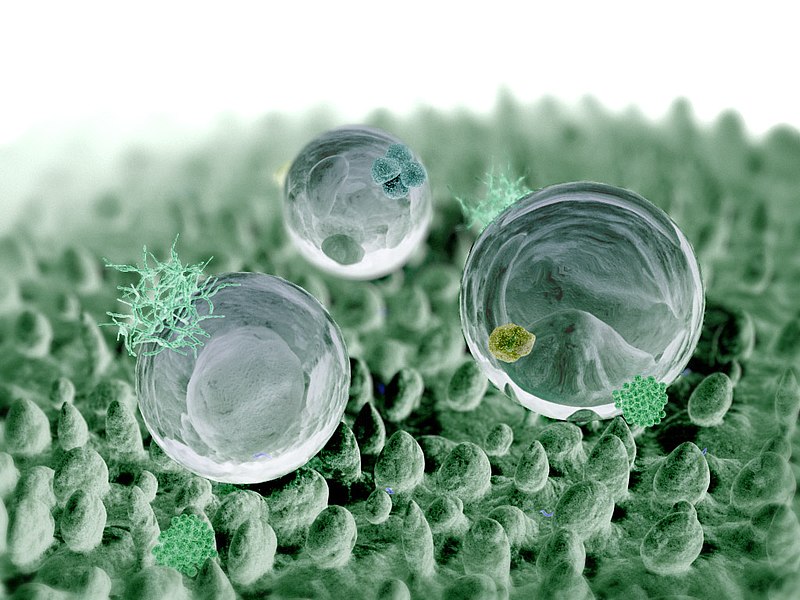
Some nanomaterials occur naturally, you can find them everywhere, volcanic ash, ocean spray, fine sand and dust. Naturally Occurring Nanostructure’s Are Also Present in Plants and Animals. For Example, nanostructures in insect eyes ensure an anti-reflection and water repelling effect so there can fly safely. Another example is lotus effect. The lotus effect is self-cleaning properties and is the result of extreme hydration, as demonstrated by the Nelumbo or “lotus flower” leaves. Dirt particles are picked up by water droplets due to the micro- and Nano sonic architecture on the surface, which minimizes the droplets adhesion to that surface.
Figure 04 :Computer graphic of a lotus leaf surface.-https://upload.wikimedia.org/wikipedia/commons/thumb/1/13/Lotus3.jpg/800px-Lotus3.jpg
Nowadays, scientists can create nanostructure themselves, by rearranging the atoms of an object, that can make new nanomaterial with new properties. For example, that are stronger, lighter or different in color.
Making new things on this incredibly small scale is called nanotechnology, which is one of the most fascinating and fast-moving fields of science today.





![If you want free storage for your downloading?? [Seedr]](https://blogger.googleusercontent.com/img/b/R29vZ2xl/AVvXsEgoCzqwCfo5-V5VeTiZecz9gzzrwWiWT2761XELreTeBQPHe6OjTWefJOiNxfD7n0u2skq2tx9ZtK-LRKE3Vv-i3gTtbeH82EEqtg8b_UWbdscJ2EiB3s3UWy5Adq8DD9gBlLdBKztB5kM/w680/nth.png)
0 Comments